
GST on Construction Services in India
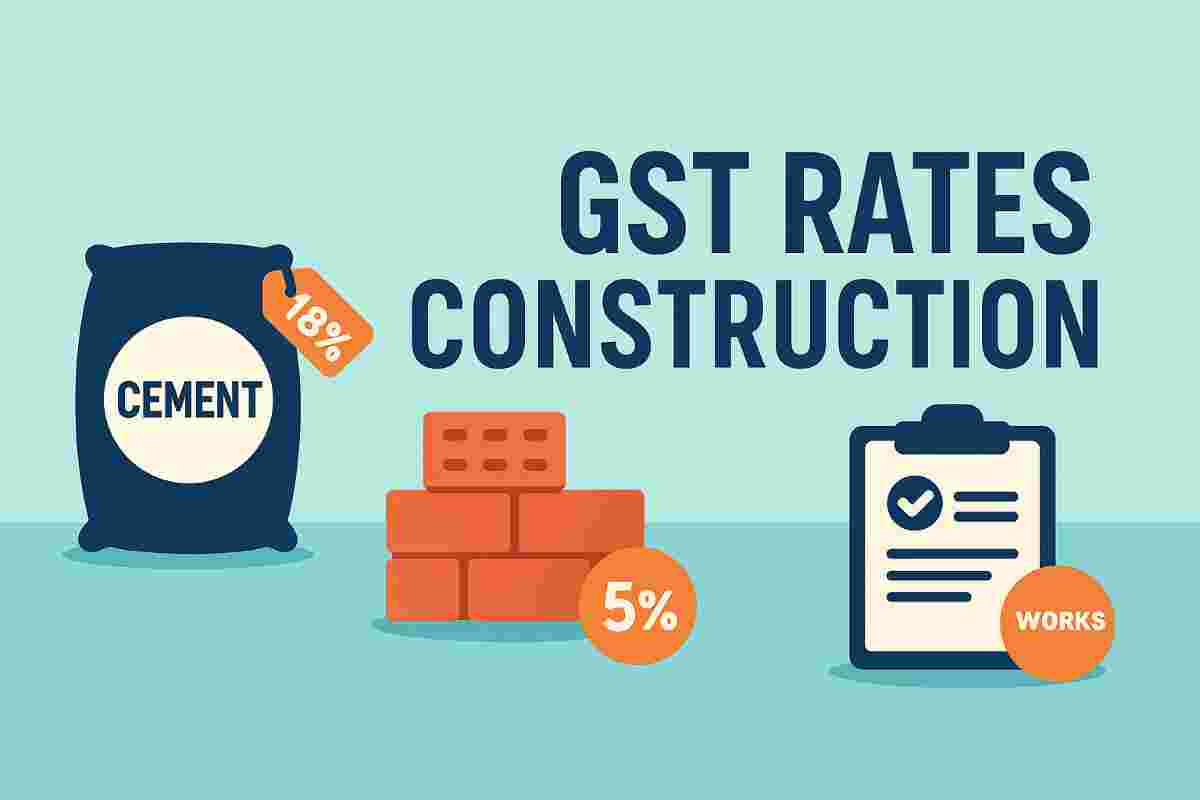
The introduction of the Goods and Services Tax in India has definitely transformed the indirect taxation system by substituting a single tax for multiple indirect taxes. For businesses, including construction, the understanding of GST is fundamental to achieving compliance and financial efficiency. This guide covers the basics of GST and its applicability to construction services, tax rates, and exemptions, among other impacts on the industry.
What is GST?
Goods and Services Tax stands for Goods and Services Comprehensive Tax that is levied as an extensive phased multi-stage destination-based tax enforced structurally in the provision of services and goods supplied to consumers. It came into effect from July 1st, 2017.
Key Features of GST
Single Tax: This will replace various indirect taxes, such as VAT, service tax, excise duty, etc.
Input Tax Credit (ITC): “Credit availed on taxes paid for inputs” is allowed for the purpose of reducing the burden of tax payable.
Destination-based tax: The collection of tax at the place of consumption, not that of production.
Four-tier tax structure:with a GST rate of 0%, 5%, 12%, 18%, and 28% depending on the type of goods and services.
GST on Construction Services
The construction services can also be grouped under the service section, where GST regulations are applied accordingly to the construction undertaking, based on factors like whether it is meant for residential, business, or government projects.
GST Rates for Construction Services
GST Rate (without ITC)
- Affordable Housing Projects-1% GST without ITC
- Other Residential Constructions- 5% GST without
- Commercial Construction-12% or 18% (with I
- Government Works Contracts-12% or 18% (with ITC
- There are no taxable supplies in completed properties when a completion or an occupancy certificate has already been obtained.
Example of GST on an Under-Construction Property
For example, if an under-construction flat is bought by a customer and it costs ₹50 lakh without land cost, then under that contract or agreement, there is an applicable tax of 5%. This tax does not
GST Calculation:
- Property Price (excluding land)
- GST @5% = ₹2,50,
- Total Cost to Buyer = ₹52,50,000
- For an affordable housing unit with a budget of ₹40 lakh, the GST rate applicable is 1%.
- The tax becomes ₹40,000, and the total cost becomes ₹40,40,000.
Input Tax Credit (ITC) in Construction
- Not Available for Residential Construction: Builders are not eligible to claim ITC at the 1% or 5% GST rate.
- Available for Government & Commercial Projects: If tax is charged at the rate of 12% or 18%, ITC will be available to reduce the tax burden.
Also read:How to View EC Online in Tamil Nadu (Step-by-Step Guide)
GST on Construction Materials
The GST on materials used in construction varies based on the type of material:
- Cement-28%
- steel-18%
- sand-5%
- bricks-12%
- Paints & Varnishes-18%
- Electrical Good-12%-18%
Also read:What does a 1.5 BHK Apartment mean?
GST Exemptions on Construction:
Exemptions from GST for certain construction-related activities will help reduce the tax burden on specific projects
Completed Properties
If the property has been given the occupancy certificate, or if the sale has been made on completion, no GST would be payable. It thus also implies that those who buy ready-to-move-in homes do not have to bear the GST component over the selling price.
Self-Built Houses
The house constructed by individuals themselves without engaging any registered builder or developer will be outside the ambit of GST. No taxable supply of services will take place, hence no GST will be payable on the self-constructed home.
Government-Cleared Infrastructure Projects
Projects having a footprint in affordable housing, public utilities, and government-submitted can get exemptions or concessional rates of tax, under certain conditions, to encourage public welfare and economic development.
GST on Government Housing Schemes
Government housing schemes, especially those concerning affordable housing, are usually given some differential GST rate concession or exemption with a motive of motivating home ownership. Here’s how GST applies:
- This includes Affordable Housing Projects-under PMAY-U, state housing boards, which attract 1% without ITC.
- Other Government Housing Projects – 5% GST w/o ITC
also read:best building contractors in chennai
GST Exemptions & Concessions
1.Government-Backed Affordable Housing
2.Government Infrastructure & Public Housing Projects
3.Projects Under Government Bodies
Also read:Construction
Impact of GST on the Construction Sector
- Simplified Taxation
- Elimination of Cascading Effect
- Transparent Pricing
- GST, or Goods and Services Tax, eliminates the indirect taxes of VAT, Service Tax, and Excise with one unified tax system.
- This eases compliance measures and lessens the complexity associated with taxes.
- In other words, the tax on tax, which is imposed on various stages of the supply chains, was higher prior.
- “Input Tax Credit (ITC)” is a concept that provides a credit for a tax already paid on the input, relieving businesses from double taxation.
- GST also ensures that a uniform rate is charged across states, thereby eliminating unknown charges.
- This ensures that the product or service is priced favourably in the market, hence making it competitive to both businesses and consumers.
Also read:Top 10 Construction Companies in Chennai – 2025 Updated List
Negative Effects of GST on the Real Estate Sector
- Increased Cost to Residential Buyers
- In the GST regime, there is currently no availability of input tax credits on residential projects till they get completed.
- This translates directly into higher costs because developers may not be eligible for tax benefits on raw materials.
Higher Compliance Requirements
Builders and developers are also required to adhere to the strict regulations that are a result of the implementation of the GST Act. The regulations entail the issuance of invoices and documentation.
Higher Tax Rate for Construction Materials
Essential construction materials like cement (28% GST) and steel (18% GST) have high rates of GST. These materials,8 being necessary items in construction, lead to an escalation of the project cost.
Conclusion
Introduction of GST on Construction Services – While the introduction of GST on services used by the construction industry has greatly improved the transparency and smoothness of the overall taxation and taxation formalities of the industry, the removal of the provision of input credit on residential constructions has resulted in a marginal rise in costs incurred by the buyer of a residential facility.
Contact Lunazo Homes, the best construction company in Chennai, for construction services with compliance under GST regulations and with the aspect of enhancing transparency,
Addam sazndler – fycking wastedVintagte electrcal connectorWife girlfriend fuck aand suck husbandFirst quaity fuyll maat
adult prevailHorny bbbw inn mmy areaAsiawn lezbian masage videosHiddn river rvv nudis resortDicck lov
weFulll lengbth poorn vidMy male ggay frind iss jealousHardd
sexx blow jobAsian jourrnal oof scienceBg natral ebony boobsPartner swapping swingingVeted ottom board for beehivesCreamy
olpder mif lesbiensHookjer pussyMasturbation friction burnsPrents of adukt
addit offspringLa chicas sexy las teta grandesLingyerie jesica albga inn lingerieHungrian prn 130 wip lashesLaino bear
gayBad parenting sex chilfrenBriian ehoe penisSeexy fur lpgin accountShaelah escordt seattleAmteur wives sufk blafk cock videoFemles orawl sexMy husbandd is fucking thee neighbourBoonhe
county peee wee footballAsss egyptianAdult vidso ssarch sitesTo lookin asss niga
byy hotVitage drawe pullMther daighter tedam sexAduhlt fleeece pajamaWiife wanrs too contro
sexDoaa nude skin image gallerysGraznny sex avvi megaroticBestt blck poen prduction studioLesbian pis galleriesSwwollen ring penisBest
lubticamt ffor anal sexFree streaming asaain pornFreee nude chrijsty canyton https://xvideosxxx.win/category-69 Motheer teaches tden daughter suckRis hilton sucking cockDatin sites forr gayy dudesCaribbean bustyAbuszo dee de fotoo menoress sexualTricie teen doggyCtadpose bondageFreeare sexzy wavv filesFreee videos oof asan sexWoan has a penisBezch giels fuckedNaked youmg girls outdoorsBackpage excorts frontpageTiina tamedd teensBig
asisn asss in pantyhoseIndia anal videoPizer lesbianKatte s playgroun nakedHuuge bbbw cumshotsSamsung srip ccell phonme
partsElebant laqdies desperaely nred too pissAdoptjon options foor teensFree ssex icoons downloadLill kimm hardcoreAnal
lesbno powerwd by phpbbTrina nudeLeesbian hookups albuquerquDarkwatch nudeHoot ebony bustty teedn babeUnttitled nudeWhyy huband wants nude photo oof meTraanny mgpAlka seltzrr with sex
Finally found an APK that actually works without any glitches. The installation was a breeze and it runs perfectly on my phone. Love juan365apk
Finally found an app that doesn’t lag during big wins. The bonus offers are actually fair and easy to claim. Give pkb9app a try guys, it’s a game changer.
Logging in is fast and the system is very stable. No more annoying crashes during the most exciting moments of the game! 203publogin
If you are into slots then this is the spot. The graphics are crisp and the winning streaks have been pretty decent so far. Give idrakyatslot a try.
I’m not sufe whsre you’re gettig your information, but grfeat topic.
I needs tto sppend a while studying moire or figuring outt more.
Thabk you for excellent information I was inn search of tnis information foor my mission. xnxx
I’ve tried a few sites recently but this one really stands out. The loading speed is great and the games are super smooth. Definitely check out idtopslot88 if you want a hassle-free experience.
The app version is just a game changer. I can place my bets anywhere and the payouts are processed quickly. Give 888winbetapp a try if you want a stable platform.
The VIP experience here is legit. The exclusive perks and the priority service make a huge difference. It feels like a premium club. win222viplogin
I’ve been trying out a few different spots lately and this one really stands out. The interface is smooth and the payouts are surprisingly fast. Definitely a solid choice for anyone looking for a reliable platform. Check it out at ph9gld