
How Foundation Grouting Saves Your Home from Cracks
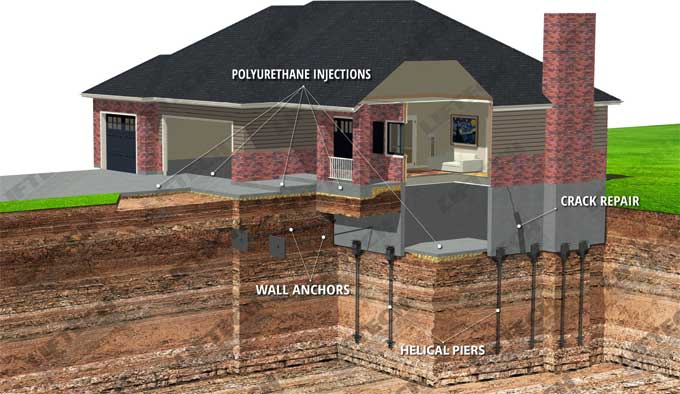
The foundation is the backbone of a building’s integrity because it provides stability and ensures long-life sustainability to the building. The foundation is essentially a connection between a building and soil and is directly associated with load distribution to ensure there are neither settlement issues nor any possibility of building failure. Kinds of foundations used in construction: The foundation selection is based on certain factors such as soil type and building load capacity requirements.
We, at Lunazo Homes,a leading house construction company in chennai are experts at conceptualizing and implementing strong foundation designs to meet the specific requirements of each individual project. In this blog post, we shall discuss various kinds of foundation types and their uses in construction, difficulties encountered, and their respective solutions to lay strong groundwork for any construction activity.
Different Types of Foundations in Construction
A foundation of the building is responsible for transmitting the weight of the structure to the soil and ensuring that there is no settlement of the structure. Classes of foundations in architecture: Types of foundation based on the installation depth and soil conditions can be categorized as shallow and deep foundations.
Shallow Foundations:
Shallow foundation is one of the many categories of construction foundations. They can be employed when thick soil deposits are present near the surface of the soil. The construction of shallow foundations is economical.
Spread or Isolated Footing:
Isolated footings are nicknamed pad footings. The purpose of using individual footings is for a solitary column. Load is evenly distributed on a specific area using individual footings. They take a square, rectangular, or circular shape. They work best in hard soil.
Applications:
- Apartments and small commercial structures
- Industrial structures with evenly spaced columns
- Regions that have a soil-bearing capacity
Strip or Continuous Footing
Strip footings are stretched underneath the length of a wall and ensure an equal distribution of weight. The types of footings are mainly seen in structures like this:
Applications:
- Low-rise residential buildings
- Buildings which have brick or stone masonry walls
- Regions in which soil conditions are moderately strong
Also read:What does a 1.5 BHK Apartment mean?
Raft or Mat Foundation
This spreads the load over a great area, covering the entire footprint of the building. It is used when the soil has a low bearing capacity, and differential settlement needs to be minimized.
Applications:
- High-rise buildings and skyscrapers
- Industrial structures having heavy loads
- Poor soil conditions that require an improved distribution of load.
also read:best building contractors in chennai
Combined Footing
When two or more columns are close to each other and their footings overlap, a combined footing is used for effective distribution of the load. These could be rectangular or trapezoidal, depending on the column arrangement.
Applications
- Buildings where space is inadequate for separate footings
- Structures with irregular column spacing cases where bearing capacity of soil is different at different places within the site.
Deep Foundations
The need for deep foundations arises when the atop soil is weak, and as such, the weight of the building has to be shifted to the deeper soil or rock layers. Such foundations are imperative in mega projects.
Pile Foundation
These are made up of thick columns made from concrete, steel, or even wood that are then pushed into the ground, and they are used in situations where soil is not stable or is falling apart, and thus cannot be used as a foundation.
Types of Piles:
End bearing piles: Load is transferred to a strong stratum well below.
Friction piles: They depend on skin friction that is distributed along the length of the pile for support.
Applications:
- High-rise buildings
- Bridges,
- piers, and
- offshore structures Regions of loose, water-saturated, expansive soils
Also read:How to View EC Online in Tamil Nadu (Step-by-Step Guide)
Caisson Foundation
The caisson foundation is prepared using prefabricated parts that are placed in position and are further filled with concrete.
Applications:
- Bridge Piers & Dock Constructions
- Offshore Oil Rigs
- Waterproof structures are designed for underwater construction work.
Also read:Sustainable Eco-Friendly Building Practices in Home Construction
Marine and Coastal Structures
Foundation Problems and Solutions of Preschools/Day
Even in the best-constructed foundations, there are possibilities of problems arising due to soil or environmental conditions. Here are some foundation problems and solutions for them:
Landslides and Irregular Foundation
Issue: Gradual soil compaction or lack of compaction leads to a situation where sections of the foundation settle, thus creating cracks on walls and floors.
Solution: Methods of underpinning using Helical/Resistance Piers might assist in lifting the foundation. Soil stabilisation techniques might assist in resisting further settlements of the foundation.
Foundation Cracks
Problem: Small hairline cracks are to be expected, but larger cracks may imply some structure damage due to soil displacement or an overload.
Solution: Small cracks can be filled by applying epoxy materials to seal them, whereas large cracks could be strengthened by installing Carbon Strips or Concretes.
Water Damage and Drainage Issues
Problem: Water will collect around the perimeter of the foundation if drainage is inadequate and cause soil erosion and a water-accumulation problem in the craw space area.
Solution: Site grading, use of French drains, and waterproof coatings can all assist with diverting water away from the foundation to prevent any issues from arising.
Also read:Top 10 Construction Companies in Chennai – 2025 Updated List
Expansive Soil Movement
Problem: The soil has a tendency to expand when it is wet and to contract when it is dry, which leads to constant soil movements that might affect the foundation of a building.
Solution: Methods such as root barrier systems, moisture barrier systems, or soil treatment methods can limit the problem of movement. Deep foundations may also be used in such soils.
Poor Construction Practices
Problem: The use of low-quality construction materials, wrong placement of reinforcement, and poor soil analysis can cause instability of the foundation.
Solution: By following good engineering practices and focusing on quality materials and soil testing, there can be no faults in foundations.
By identifying these possible issues in the foundations from an early stage, Lunazo homes ensures the integrity of the structure in the years to come.
Grouting in Construction: Meaning, Types, Methods and Real-Life Examples
Grouting in construction refers to the process of injecting a fluid or liquid-like material (called grout) into voids, cracks, joints, or between structural elements to:
- Fill gaps
- Reinforce weakened zones
- Prevent water leakage
- Improve the load-bearing capacity of soil or concrete
Also read :buiders in chennai
How Foundation Grouting Saves Your Home from Cracks
Cracks in floors, walls, or foundations could be indicative of bigger problems. In India, where foundation problems may be caused by soil shifts, water, or old buildings, foundation grouting is an effective solution that requires no reconstruction.
What is Foundation Grouting?
Foundation grouting is a process where cement-based grout is injected under pressure into the soil or cracks beneath your home’s foundation. This fills voids, lifts settled areas, and strengthens the base.
Common Causes of Foundation Cracks:
● Uneven settlement of soil
● Water seepage below the foundation
● Poor compaction during construction
● Tree roots or underground utilities shifting soil
How Grouting Helps:
● Fills hidden voids beneath foundation slabs
● Re-levels sunken floors or plinths
● Prevents further settlement and cracking
● Restores load-bearing capacity of soil
● Saves time and money compared to total rebuilding
Purpose of Grouting in Construction
Grouting has many important applications, such as
- Leaks in underground constructions such as tunnels and basements
- Preventing soil instability beneath foundations or slabs
- Strengthening damaged concrete or masonry
- Securing bolts, machines, and rebar to concrete foundation bases
- Prevention of ground settlement
Types of Grouting in Construction
Depending on the intended use, environment, and structural requirements, various methods of grouting are used. Here is a classification of the various types of grouting that occur in construction:
Cement Grouting
- In addition to being less expensive to manufacture, this product has a simpler
- Frequent in dam repairs, masonry joints, foundations
- Cost-effective and versatile
- Grouting cement is applied for filling cracks in RCC Slabs.
Chemical Grouting
● Uses chemical resins like polyurethane, epoxy, or acrylic
● Ideal for waterproofing or sealing fine cracks
● Expands upon injection to fill micro voids
3. Epoxy Grouting
● Made from epoxy resin and hardener
● Used for machinery baseplates and anchoring systems
● High strength and chemical resistance
4. Bituminous Grouting
● Asphalt-based
● Used in road construction and waterproofing expansion joints
5. Soil Grouting
● Also called permeation grouting
● Improves the strength and stiffness of loose or sandy soils
Methods of Grouting in Construction
Various grouting methods are used in construction, each selected based on the type of structure, soil conditions, and purpose—such as strengthening foundations, sealing leaks, or filling voids.
1. Pressure Grouting (Injection Grouting)
Grout is injected under pressure through drilled holes.
Common in structural repairs and soil stabilization.
2. Permeation Grouting
Injects grout into porous soils without disturbing the ground.
Used in foundations, tunnels, and pipelines.
3. Compaction Grouting
Thick grout is injected to compact and displace weak soil.
4. Jet Grouting
High-pressure jets create a grout-soil mixture.
Effective in deep foundations or below existing buildings.
Grouting Material and Their Properties
The success of grouting work in construction depends heavily on choosing the right grouting material:
Cementitious Grout
Concrete repair, dam joints, masonry gaps
Epoxy Grout
Anchoring machinery, base plates
Polyurethane Grout
Sealing water leaks in tunnels/basements
Acrylic Resin Grout
Soil injection, water cut-off
Fly Ash or Bentonite
Used as additives to reduce cost or improve flow
Grouting Equipment in Construction
Modern grouting equipment in construction ensures fast, efficient, and high-quality application. Common tools include
● Grouting machine in construction (manual or automatic pumps)
● Injection packers and hoses
● Mixing drums and agitators
● Nozzles for tile or wall grouting
● Jet grouting rigs (for deep foundation soil work
Grouting in Construction in India: Real-World Examples
1.Delhi Metro Tunnel – Groundwater Seepage Sealed with Chemical Grouting, Underground Metro Line, New Delhi
Problem Statement: During the tunnel construction process, leakage of groundwater was observed in the joints of the segments as well as in the concrete lining of the metro tunnels, which would otherwise lead to the corrosion of the reinforcement and weakening of the tunnels.
Technical details of the problem: Leakage of groundwater was observed in the joints of the segments. The leakage was also present in the concrete lining
Solution: The solution adopted by the construction team was polyurethane-based chemical grouting. This is a technique that involves the injection of an expanding polyurethane resin into the leakage points. This substance will react with water and will swell immediately to form a flexible impermeable barrier.
Outcome:
● Long-term waterproofing was achieved
● Tunnel integrity preserved without structural alteration
● Zero downtime in construction schedule
● The method proved ideal for grouting work in construction under high-moisture and pressure condition.
2.Tehri Dam, Uttarakhand – Foundation Stabilization Using Cement Grouting
Outcome:
● Rock voids and joints were sealed effectively
● Hydraulic uplift and seepage risks were mitigated
● The grout curtain enhanced structural safety without disturbing the dam body
● A classic use case for cement grouting in construction in India
Problem: The underlying rock foundation of this large hydroelectric dam was known for having seepage paths and permeability that posed a potential threat to the stability of the structure, which was highly susceptible to seismic events.
Solution: They used high-pressure cement grouting in the deep foundation of the dam. It involved a number of borehole injections of a prepared non-shrink cement grout to form a grout curtain, which is a vertical barrier to minimize permeability of water.
3.Soil Settlement in Indian Homes – Residential Foundation , Residential areas in Chennai, Bengaluru, Hyderabad
Problem: Older residential structures may be prone to foundation cracks and floor settlement due to soil erosion, poor compaction, or waterlogging, which may be prevalent in clay-rich soil conditions in many Indian cities.
Method: Contractors employed pressure grouting, a procedure wherein cement grout was injected into holes drilled below the sunken slab. This was done using a portable grouting pump.
This method was preferred due to its cost effectiveness and non-intrusive nature.
Important Grouting Equipment in Construction:
● Hand-operated or motorized grouting machine in construction
● Grout mixer and agitator
● Injection packers for controlled delivery
Result:
● Foundation level restored within hours
● Prevented further structural damage
● Improved bearing capacity of underlying soil
● A practical demonstration of grouting in construction in India for residential building.
FAQs on Grouting in Construction
Why is foundation selection important in construction?
Foundation selection is very important since it ensures that the building has stability and prevents any settlement problem or failure due to the weight of the building that it has to carry. Proper foundation choice out of the varieties in construction not only aids in controlling soil movements but also helps in draining water.
What factors influence the choice of foundation for a building?
Several factors affect types of foundations in construction selection, including:
Soil type and bearing capacity
Load of the structure
Water table level
Environmental conditions like seismic activity and flooding
Budget and construction feasibility
What is the difference between shallow and deep foundations?
Shallow foundations are used in situations where strong soil is accessible, while deep foundations rely on the load being transferred to deeper and stronger soil layers. Shallow foundations are cheaper, while deep foundations are needed in high-rise structures, bridges, and buildings on weak soil.
How can I detect foundation issues in my building?
Signs of foundation problems include:
Cracks in walls, flooring, and ceilings
Uneven or sloping floors
Doors and Windows That Stick or Will Not Close
Water accumulation around foundation
Gaps between foundation and structure of visible type
How can foundation problems be fixed?
Solutions depend on the issue that happened in the type of foundations in construction but may include:
Underpinning techniques to strengthen weak foundations
Installing drainage systems to prevent water damage
Using expansion joints or reinforcement for crack repair
Soil stabilization methods to prevent shifting
How long does a foundation last?
A well-constructed foundation can last for several decades or even centuries if properly maintained. Factors like soil conditions, construction quality, and environmental exposure affect its lifespan.
Does Lunazo homes provide customized foundation solutions?
Yes, Lunazo homes specializes in all types of foundations in construction providing customized foundation solutions based on thorough soil analysis, structural requirements, and environmental factors to ensure long-term durability and stability.
What are the types of grouting
Grouting performed on construction projects can have different types depending on a set of factors
Cement Grouting,
Chemical Grouting,
Epoxy Grouting,
Bituminous Grouting,
Soil Grouting.
Which machine is used for grouting?
Grouting machines may be equipped with high-pressure pumps, manually operated pumps, or specially designed jet grouting machines to be used in deep foundation applications.
Are grout and mortar different?
Yes. Grout is more fluid, whereas it is used as a filling material, while the mortar is used as an adhesive for the bricks or blocks.
Can grouting eliminate water leakage?
Definitely. Chemical grouts such as polyurethane can certainly seal and stop active leaks in tunnels, dams, and basements.
Application of Grout Lunazo homes
Lunazo Homes, a leading house construction company in chennai is the most distinctive construction firm in Chennai, famous for its quality-centric methodology, innovative processes, and timely completion of projects. We apply the process of grouting to improve foundations, fill gaps in the structure, and prevent water leakage in our construction work. Starting from cement grouting in slabs to chemical grouting in basements, our contractors are very reliable for safe structure construction.
Conclusion
Grouting is more than a filler. it is a crucial application that helps strengthen, seal, support, and stabilize several elements of construction. Ranging from the stabilization of soils beneath a constructed building to the installation of heavy machineries, grouting has proven to be a game-changer.
As a builder, engineer, student, or home owner, to know the types of grouting in construction, grouting procedure, equipment, and material is essential to assist you in taking proper decisions in your construction project.